A substantial public archive
Marc Taro Holmes’s Citizen Sketcher site brings together his location-drawing books, demonstrations, sketching challenges and watercolour work. His biography records his role as an Urban Sketchers correspondent, instructor and board member, and identifies books including The Urban Sketcher and Direct Watercolor. The site’s index is a useful route into his own material. It includes paid and free resources; our exercise requires neither a purchase nor a particular kit.
Think in shapes before outlines
A brush-first study asks you to place a shape with a value and an edge, often before enclosing it with a pen line. That is still drawing: you are choosing proportion, direction and relationship. It can expose a habit of relying on outlines to make every object separate. Try looking for where neighbouring objects merge into one observed dark instead.
Keep the experiment small
For our independent exercise, select one doorway and its shadow. Paint the main light and dark relationships directly with a medium brush, using a page small enough to finish in fifteen minutes. Reserve a little paper. Add line only at the end, and only if you can name what it clarifies. The aim is not to make a loose-looking picture on command; it is to discover what the brush can describe by itself.
Review the edge decisions
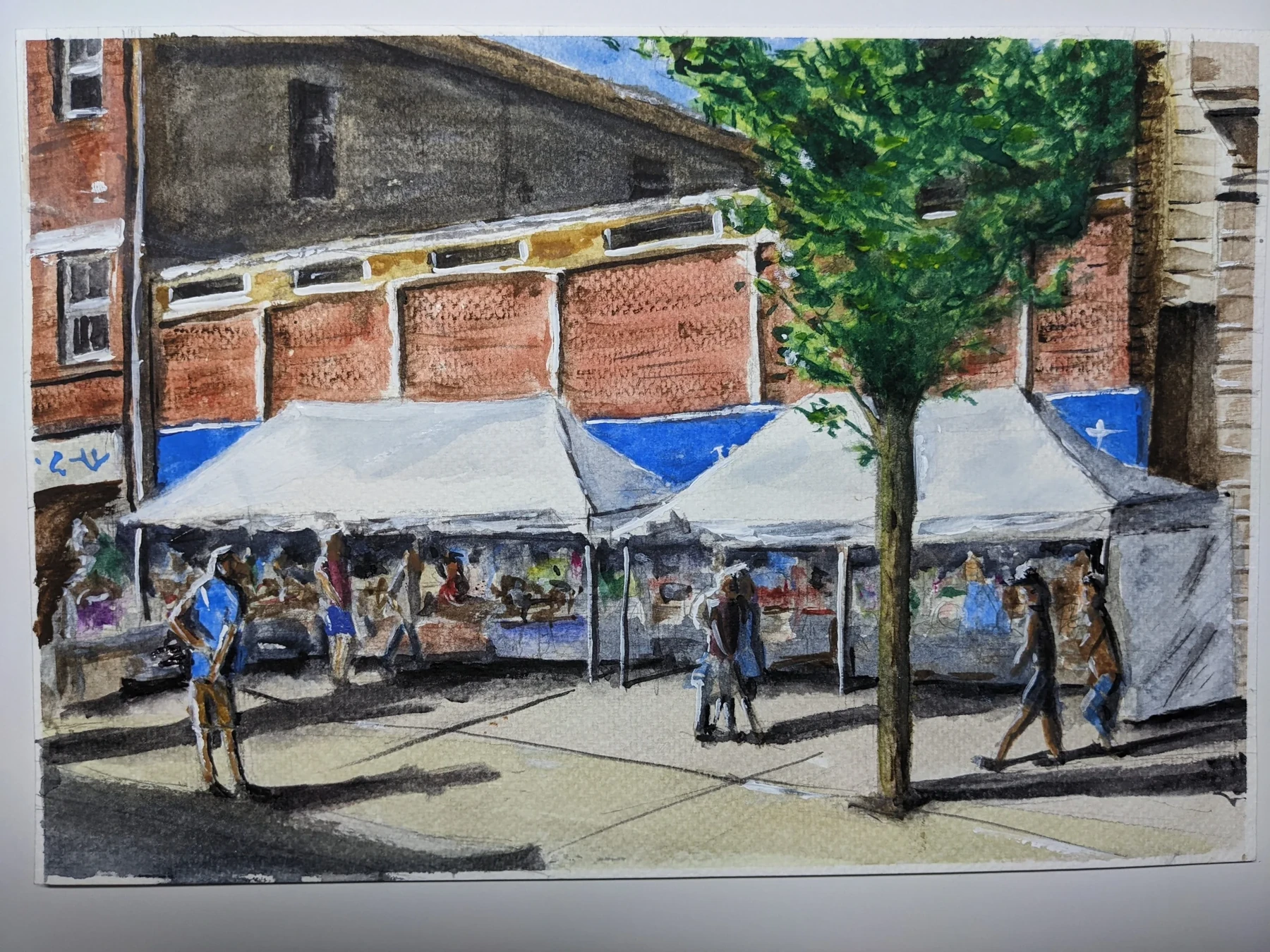
Find one edge that is doing useful work and one that could disappear. A painting does not need equal certainty everywhere. The Southport illustration here is Mark’s companion painting, not a Holmes example. Use the artist’s original archive to see his work and methods, and use your own observed subject to test the question.
Your turn · 20 minutes
Take it to the page.
- Choose one doorway and one connected shadow.
- Paint the large shapes before any pen outline.
- Add no more than three clarifying lines after the wash dries.
Look back: What could the brush describe without a drawn boundary?
Sources & further looking
- Illustration: Long Shadows, Southport by Mark C Grant ↗
- Marc Taro Holmes: Citizen Sketcher index ↗
- Marc Taro Holmes: biography ↗
Close-looking observations and practical exercises are this publication’s interpretation. Illustration credits are shown beside each work.