The revolution will bring its own water pot
There is something wonderfully un-grand about a movement whose essential equipment fits beside a sandwich. No cavernous studio. No requirement to stare moodily at a blank canvas until a patron arrives. A sketchbook, a pen, a patch of pavement you are not blocking, and an interest in whatever the world is getting up to. The bus might feature. So might the person waiting for it. Both have more going on than they first let on.
“Urban sketching” is a good name for that invitation. It sounds like an activity you could try this afternoon. The emphasis falls on the place and the doing, rather than a qualification you ought to possess before leaving the house. You can be a beginner, an architect, a retired teacher, a painter having a day off from painting, or someone who bought a notebook three years ago and has been saving it for a sufficiently important occasion. This is the occasion.
First came the looking. Then came the internet
Artists were drawing their surroundings long before anyone uploaded a thumbnail. The modern Urban Sketchers community has a more specific origin. Its own history dates the beginnings to Gabriel Campanario’s Flickr forum in 2007, followed by an invited-correspondent blog in 2008. The organisation became a Washington-state nonprofit in 2009; the first international symposium took place in Portland, Oregon, in 2010.
The novelty was the connection. A modest drawing made in one town could sit beside a page from another continent. A street corner ceased to be merely a subject and became a way of saying: this is what my bit of the world looks like today. You did not need to manufacture an exotic life. You needed to pay attention to the one outside the window.
Campanario’s own biography places his weekly Seattle Times sketching column between 2009 and 2021. That reporting background matters to the story. A drawing can carry information, curiosity and an encounter as well as a handsome arrangement of shapes. The page can ask what is happening here, rather than only whether the roofline is behaving itself.
Thirteen people by the water
Tina Koyama’s 2024 history for Urban Sketchers Seattle describes an early connection between Campanario and architectural author Frank Ching. After meeting over coffee, they arranged to draw at Fishermen’s Terminal. Her account records thirteen sketchers at the chapter’s first outing on 19 July 2009, and identifies the existing World Wide SketchCrawl events as an encouragement to invite others.
That is an appealingly human route from online idea to actual community: have a conversation, choose somewhere to meet, turn up. The screen helped people find each other; the drawing gave them a reason to stay. There is room for quiet company in that arrangement. You need not produce a brilliant opening line when both of you are busy wondering where the ferry’s bow has gone.
Plein air is fine. It just leaves the café out
The National Gallery defines plein air as painting out of doors, in front of a landscape or another subject, rather than in a studio. It is a useful historical term, and there is no need to evict it from the language. Monet can keep his paperwork.
But “urban sketching” feels a better invitation for this publication. It comfortably suggests the bus stop, the market, the railway concourse and a cup going cold beside a half-drawn window. The official Urban Sketchers definition includes direct observation indoors and outdoors and allows different media. The distinction is not “posh painting versus proper people”. It is a difference of emphasis. One term describes working in the open air; the other brings the record of a place, a moment and a shared practice into view.
Nor does the word urban mean you must locate a skyscraper before opening the book. The chapter guidance explicitly welcomes rural places too. A village shop, a farm or a beach can carry the same attentive record. What matters is being clear about what you observed, where you were, and what you have added later.
A manifesto without a compulsory drawing style
The organisation’s manifesto centres observation, honest records of places, individual approaches and sharing with other sketchers. Read it as an agreement about the relationship with the subject, rather than a demand for a particular fashionable line. A wobbly pen drawing and a patient watercolour can belong in the same conversation.
That gives the beginner a useful bit of freedom. You do not have to counterfeit someone else’s elegant wobble. Yours will arrive quite naturally, thank you. Equally, confident draughtsmanship is welcome. Nobody needs to damage a perfectly serviceable drawing to demonstrate that they are relaxed.
There is one useful honesty to keep: an illustration made from a photograph is a photo study. It may be lovely. It may teach you plenty. Calling it that costs nothing and leaves the phrase “drawn on location” with something real to mean.
The city has more stories than pretty façades
Urban Sketchers’ Reportage Grant programme, introduced in 2021 according to its 2026 call, makes the storytelling ambition explicit. The programme describes reportage as observed drawing combined with narrative, context, research and, where appropriate, interviews. A market at work or a neighbourhood undergoing change can be more than attractive scenery.
That is where a sketchbook becomes particularly interesting. A single page might show a shuttered shop. A sequence can record who uses the street, when the deliveries arrive, what has changed and what people say about it. The accompanying words should distinguish what you witnessed from what you learned elsewhere. A jaunty pen line is not a licence to guess.
None of this obliges every lunchtime sketch to become investigative journalism. Sometimes a chair is a chair, and drawing its awkward legs is quite enough. It simply widens the possibilities beyond collecting famous buildings like stamps.
Find your people. Check the actual meeting
Our world map uses a dated snapshot of the official public chapter directory. It points you towards groups and their own pages. Some organisations have several location pins; some records lead back to the official directory because no group website is supplied. These are places to begin looking, not promises that somebody will be standing there next Saturday.
Check the group’s latest announcement, meeting instructions and access information. Introduce yourself if asked, bring a small kit, and let the first outing be a first outing. You are allowed to be interested without already being excellent. If the group puts sketchbooks together at the end, notice how differently everyone has seen the same place. That is the point, rather than a problem to be corrected.
The ordinary world has not run out
The strongest argument for urban sketching is still waiting outside. A familiar corner changes with light, weather, trade, people and your own attention. Go back twice and you are unlikely to make the same page. Go back a dozen times and the supposedly uninteresting place may begin to look suspiciously rich.
A global movement is a splendid thing. So is having a reason to spend twenty minutes looking properly at the end of your own road. Bring the folding stool if it helps. Leave the need to be impressive at home. There should be room in the bag once that has gone.
Your turn · 20 minutes
Take it to the page.
- Open the Groups map and find one chapter whose area interests you; read its current public information.
- Draw a small place from direct observation for twenty minutes.
- Add the location, date and one observed fact. Share the page if you want to; no performance required.
Look back: Does the page tell someone something particular about this place and moment?
Sources & further looking
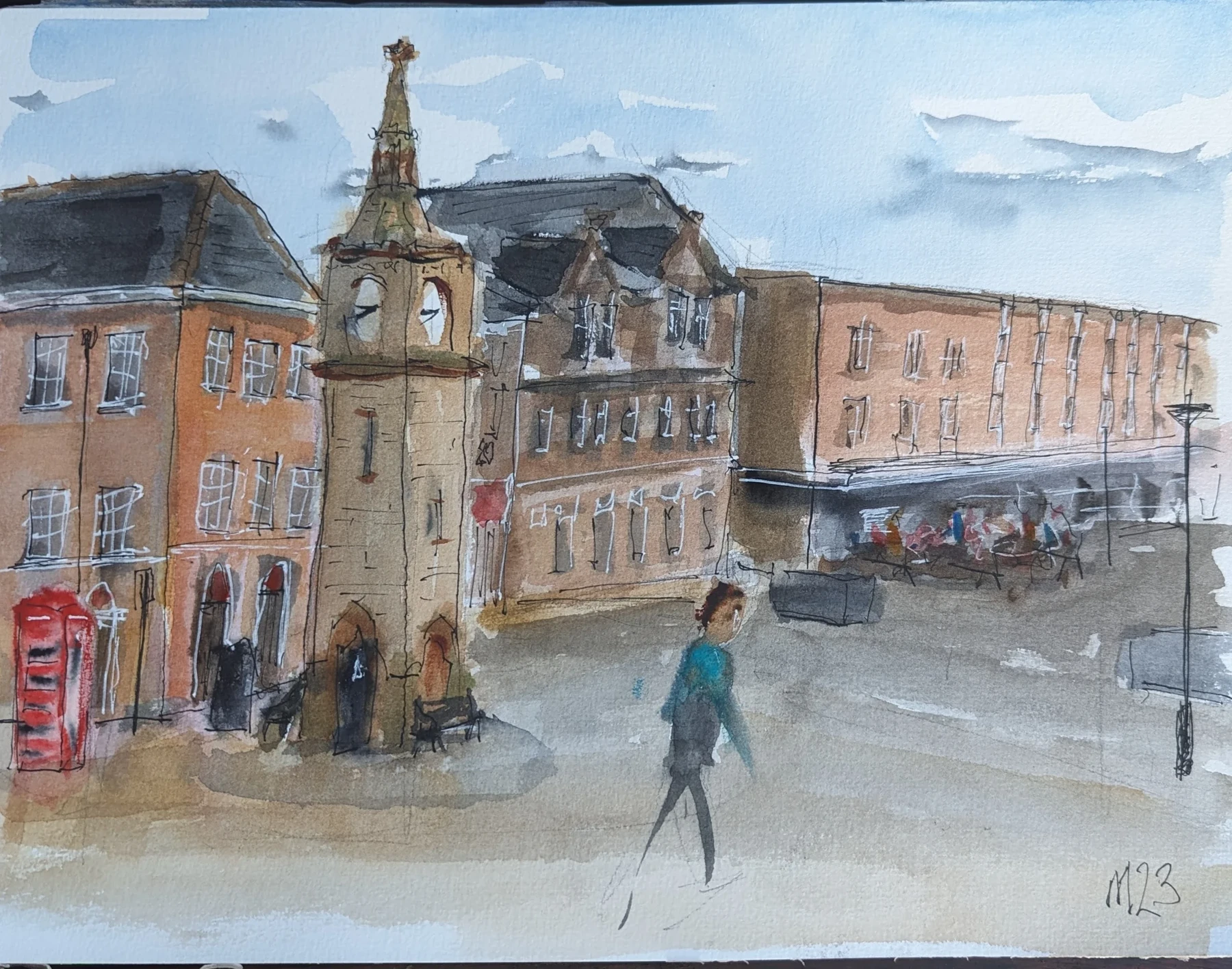
- Illustration: Market Stalls, Ormskirk by Mark C Grant ↗
- Urban Sketchers: organisational history and manifesto ↗
- Gabriel Campanario: biography and Seattle Times work ↗
- Tina Koyama: Seattle chapter’s fifteen-year history, 2024 ↗
- National Gallery: the meaning of plein air ↗
- Urban Sketchers: chapter FAQs, including rural sketching ↗
- Urban Sketchers: 2026 reportage programme and its 2021 beginnings ↗
- Urban Sketchers: what reportage involves ↗
- Find groups on our world map ↗
Close-looking observations and practical exercises are this publication’s interpretation. Illustration credits are shown beside each work.