Look where the attention is not
A landmark arrives with a ready-made picture in your head. An ordinary stretch of pavement asks you to look before deciding what the picture should be. The gap between a tree and a wall, a row of shutters, or the way afternoon light divides a path can become a subject without needing a visitor centre.
Time makes a familiar place different
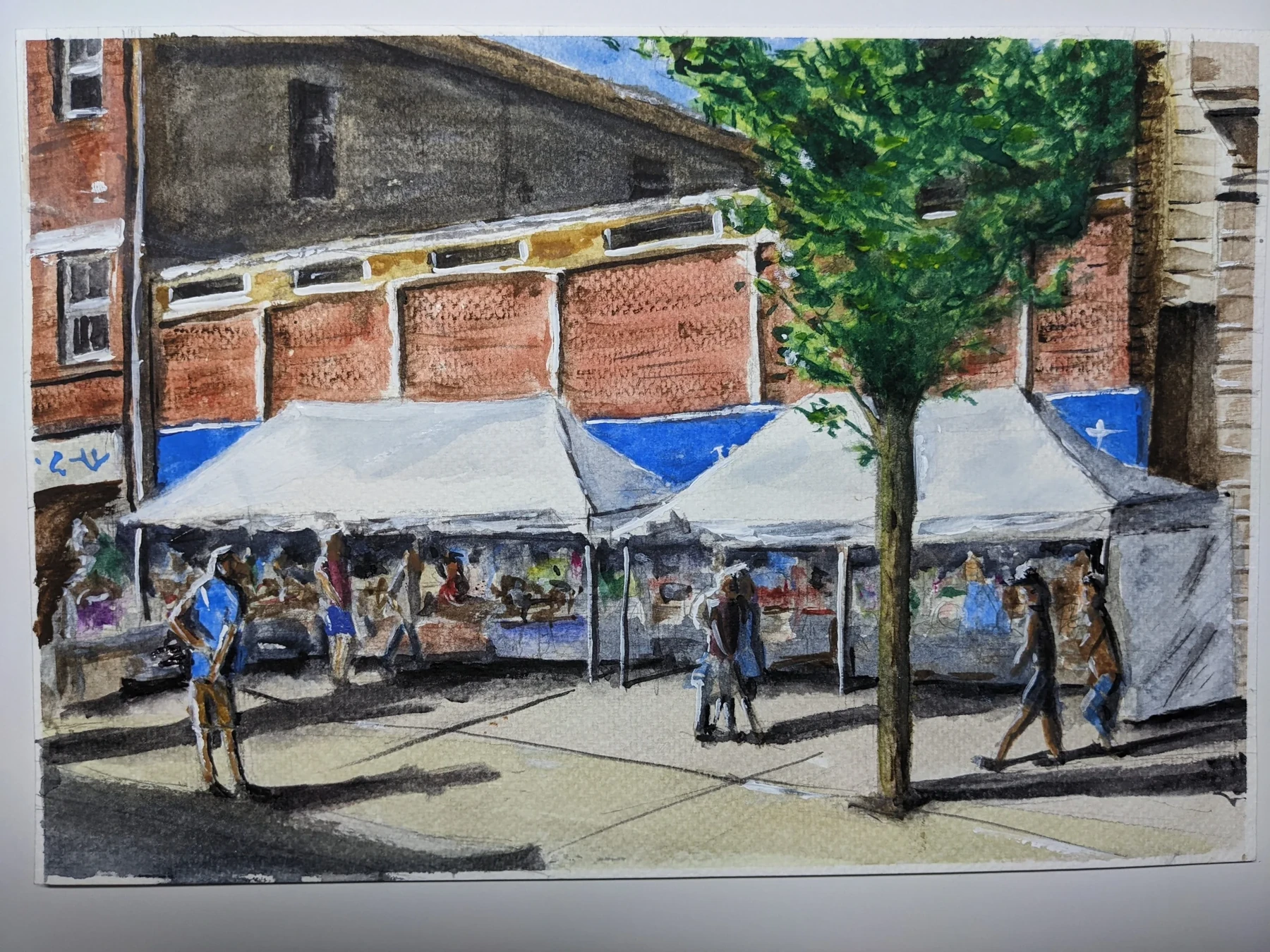
Mark’s Southport painting lets long shadows cross the foreground. Their angles give the page a rhythm that the buildings alone would not provide. Look for a similarly temporary structure in your own street: a shadow, a queue, a reflection or a patch of light. Draw what is actually present, then note the time so that the changing condition becomes part of the record.
Specificity is kinder than a slogan
Avoid turning a neighbourhood into a mood board. Signs, surfaces and ordinary uses are worth observing on their own terms. A place is not made more truthful by adding “gritty” to the caption. Describe what you can see, acknowledge what you do not know, and allow the people who use it to remain more than background atmosphere.
Return once
Choose one safe, accessible spot and revisit at a different time. Keep the framing similar. Compare the occupied spaces, the light and the details you noticed on the second visit. A modest repeated view can build a deeper record than a collection of impressive façades hurried past.
Your turn · 25 minutes
Take it to the page.
- Choose a familiar place with no obvious landmark in the frame.
- Make a small drawing organised around light, overlap or a repeated shape.
- Return on another day and use the same framing; write two observed differences.
Look back: What changed in the place, and what changed in your attention?
Sources & further looking
Close-looking observations and practical exercises are this publication’s interpretation. Illustration credits are shown beside each work.