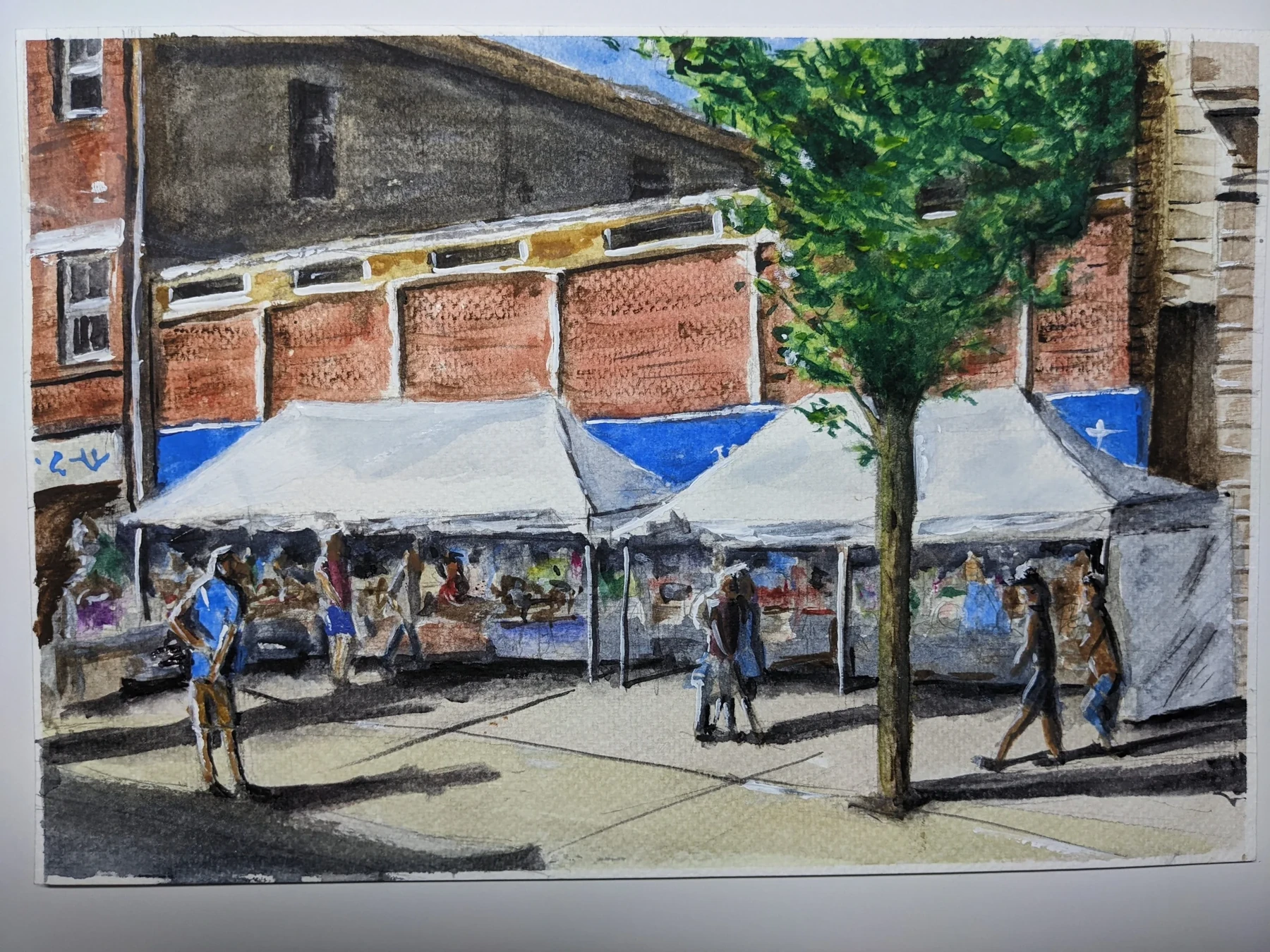
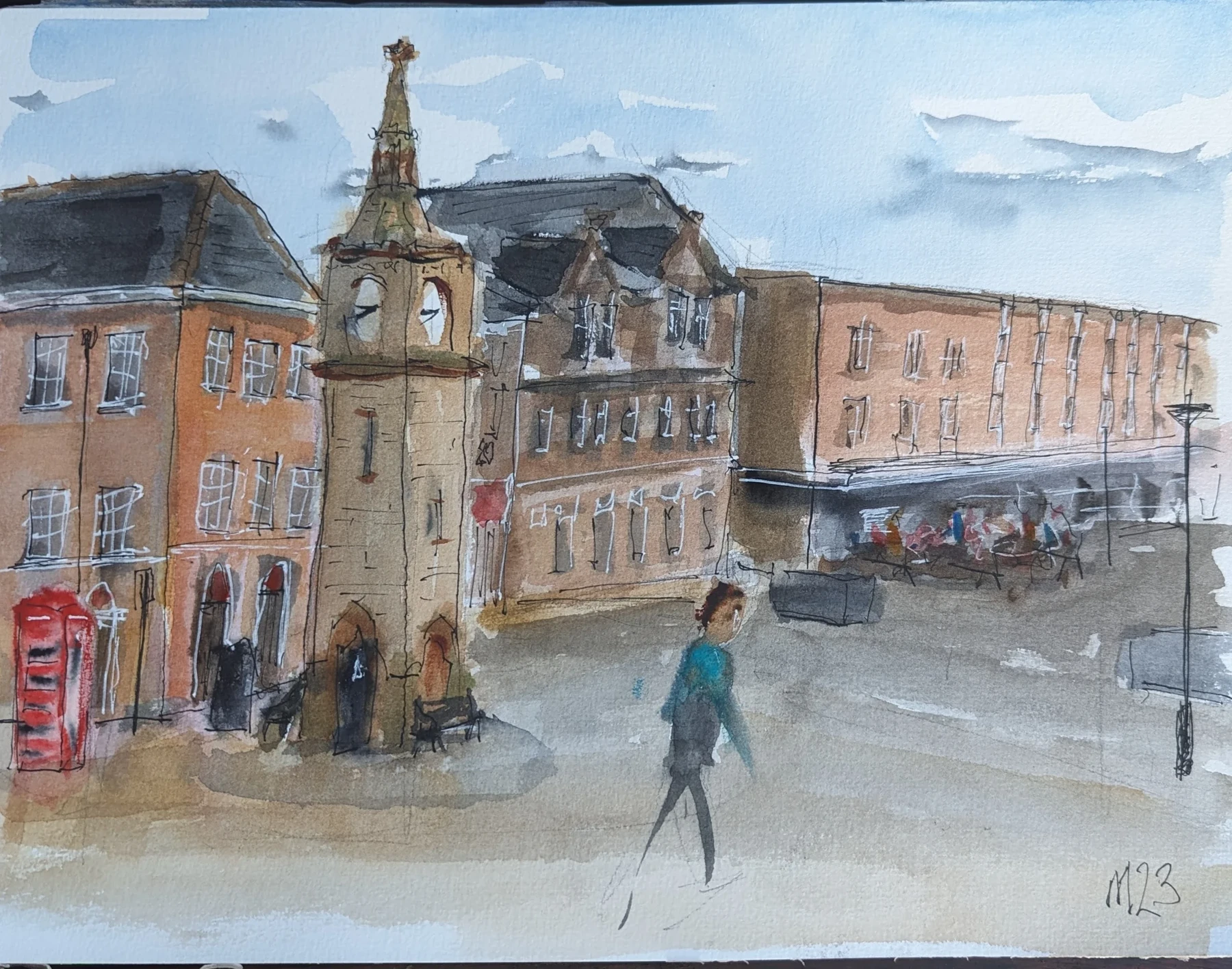
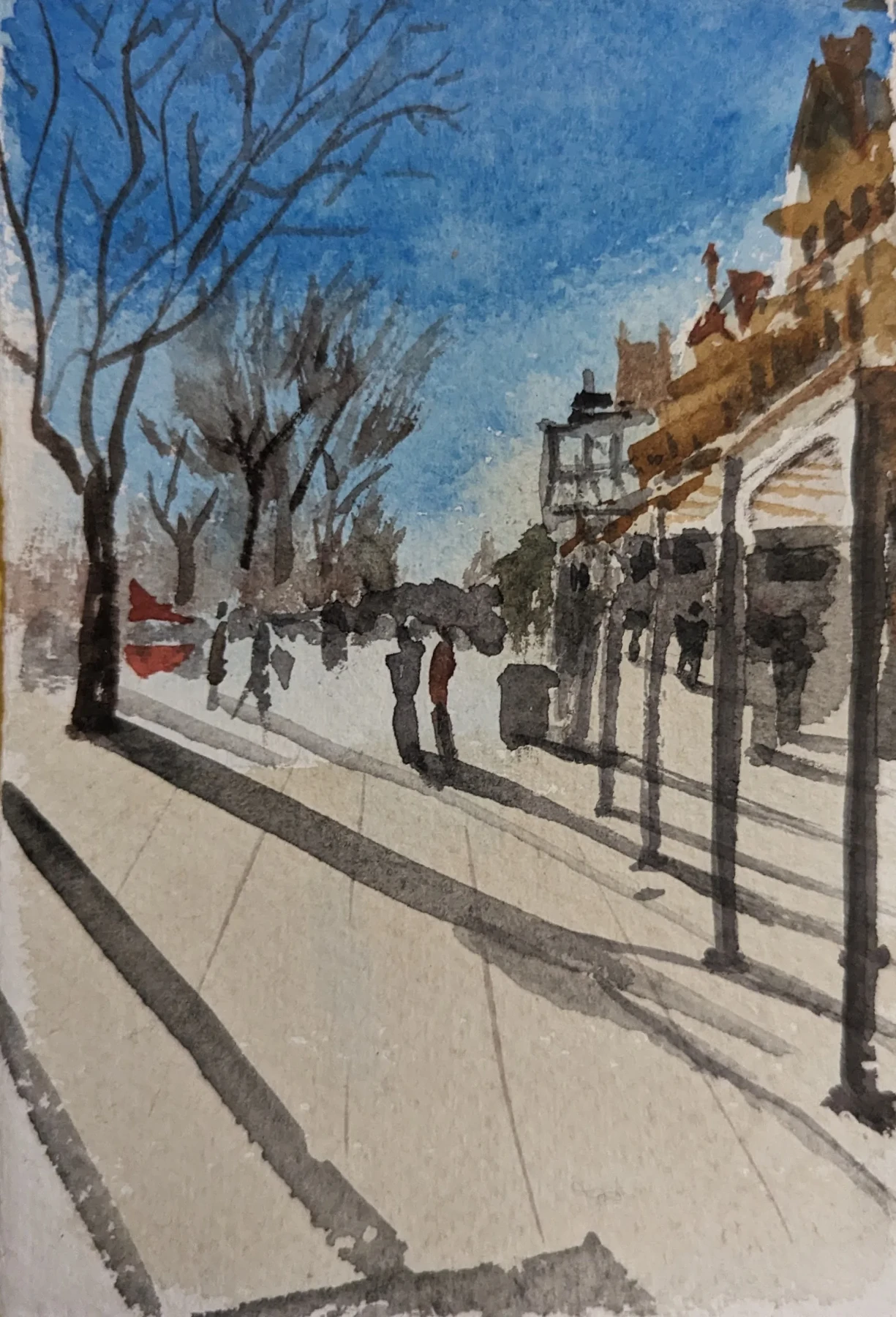
The painting has your attention
The shine is leaving one patch of wash. Another is still wet enough for the colour to move. A narrow strip of paper has to remain clear, while the shadow beside it will be stronger later. The brush pauses. Something else on the page is ready. There is plenty to think about, but the thinking belongs to the painting.
This is a familiar kind of absorption in making: looking, judging, remembering and anticipating become closely joined. The street and the page keep supplying the next question. There may be less room for rehearsing yesterday’s conversation or tomorrow’s difficulties because a relationship is already under way, between the eye, the hand, the material and the place.
It would be an odd moment for somebody to lean over a painter’s shoulder and ask whether they were being sufficiently mindful. The question changes the activity. Now there is an experience to inspect and a result to report. The painting had been enough. Understanding its absorption begins with allowing that fact some weight.
What flow originally meant
Psychologist Mihaly Csikszentmihalyi developed the idea of flow as an account of deeply rewarding involvement in an activity. His Beyond Boredom and Anxiety first appeared in 1975. The later formulation by Jeanne Nakamura and Csikszentmihalyi describes intense concentration on the activity, a joining of action and awareness, reduced reflective self-consciousness and an altered sense of time. The activity becomes rewarding in itself. [1] [2]
The theory distinguishes conditions that can favour flow from the experience itself. A person has a challenge that engages their abilities, a sense of what the next action is for, and feedback that makes the consequences intelligible. These describe a relationship between a person and a task. They are not a switch that a person can press. [2]
Csikszentmihalyi’s 2004 TED talk, linked and playable below, gives his own account. In drawing, the distinction between being occupied and being absorbed is useful. A sketcher can be occupied by counting windows while wishing to be elsewhere. In a more absorbed passage, the changing relationships on the page hold the interest: this interval, this edge, this colour answering another. [3]
The ease has a history
Flow does not arrive automatically when a brush touches paper. A painter brings a history of working with it: how much water the brush carries, what this paper does, the familiar movement of laying a wash, the signs that an edge is beginning to dry. Some decisions no longer require a sentence of instruction before the hand can act.
That familiarity can change the quality of effort. At first, a painter may have to think separately about loading the brush, placing it, keeping a wash moving and preserving a light. With experience, parts of that work can become fluent enough to support a larger intention. Attention is still active, but it is less continuously occupied by the mechanics of each movement. The ease has been learned through many less easy pages.
In the flow account, the fit between challenge and ability matters. A task far beyond what someone can currently manage may become bewildering; a thoroughly predictable one may fail to hold interest. Familiarity makes a more responsive engagement possible, while the unresolved painting still supplies a challenge. Accomplishment alone does not guarantee absorption, and a beginner can have absorbed passages within a task that meets their developing skills. [2] [3]
This is why “effortless” needs care. The experience can feel less strained while involving considerable skill and concentration. A pianist still hears the phrase; a painter still judges the wash. What has eased is the need to supervise every component as an isolated problem. The person and the process have become more closely acquainted.
Looking becomes a continuing conversation
In observational drawing, the eye travels between the subject and the page. A shelf’s edge changes angle near the corner. A pale opening makes a neighbouring dark legible. The drawing gives something back: that side is too wide, this gap matters, the shape needs less explanation. Looking leads to a mark, and the mark changes what is looked for next.
Mark C Grant’s Waterstones, Liverpool, shown above, makes those relationships visible. The shelves gather many separate books into a few long directions. Small colours interrupt the greys; the pale opening behind the central display gives the interior depth. The picture offers a record of selected relationships, rather than a complete inventory of the room.
This scanning is purposeful. It can be quick, patient, uncertain or fluent. In an absorbed passage, perception and response become closely connected enough that there is little spare interest in commenting on oneself doing them. The local question keeps changing, but it remains attached to the same encounter. The place has ceased to be a backdrop.
Watercolour holds several times at once
Watercolour makes the temporal complexity especially clear. The page contains a recent past: water already laid, pigment already moving, a first wash now settled. It contains a future held in intention: a darker note when the surface is ready, an area that must remain dry, a light that will stay untouched, a loose shape that may later become a figure. All of this bears on what the hand does now.
The absorption lies in precisely this interdependence: holding wet states in mind, anticipating the return to a damp passage, remembering what needs to stay dry and recognising what the painting is becoming. “Being in the present” acquires a richer meaning here than having no thoughts about before or after.
There are material reasons for it. Canson’s account of wet and dry paper explains how water changes the spread and definition of a mark, with drying affected by the paper and the surroundings. Watercolourist Renee Walden describes the changing stages of a wet passage and the need to keep track of how different parts of a painting are drying. A surface is continuously becoming a different surface. [7] [8]
The remembered wash and the anticipated return are therefore part of present work. They concern this patch of water and pigment, with consequences available to the senses. They differ from the unrelated mental journeys that can carry a person away from what they are doing. Absorption can organise memory and anticipation around one unfolding activity.
A painting can carry finished decisions, active movement, approaching opportunities and protected possibilities together. Its present is thick with what has happened and what might happen next. The moment of creation contains those relationships.
The demand can also exceed someone’s available attention. Several washes drying at once may feel like too many pans on the hob. Greater knowledge of the process can make the same situation more readable, but the medium does not guarantee flow. The interest lies in how a painter learns to stay in relationship with something that will not stand still.
Mindful, without a running commentary
Why call any of this mindful? Because attention is closely engaged with what is happening, responsive to change and less dominated by a separate story about the self. The person is in contact with the activity. They need not keep announcing that contact to themselves for it to matter.
There is nevertheless a distinction between flow and mindfulness as researchers define and measure them. A 2015 paper by Kennon Sheldon, Mike Prentice and Marc Halusic found negative relationships between mindfulness and the absorption aspect of flow across three studies, including an experiment using Tetris after a mindfulness induction. Their finding concerned absorption, rather than the sense-of-control aspect of flow. It supports taking the difference seriously; it does not establish that all mindful awareness disrupts all creative activity. [4]
A wider 2023 meta-analysis by Nicola Schutte and John Malouff combined 17 studies involving 10,102 people. Overall, greater mindfulness was associated with greater flow, with a stronger relationship for habitual tendencies than for momentary states. An association across people or occasions does not mean that deliberately checking your state will deepen absorption during a particular brushstroke. [5]
The connection can be understood without making the two terms interchangeable. Flow describes absorption in doing; mindfulness can describe a receptive quality of attending. A painter may recognise aspects of both while having little interest in naming either. Asking “am I in flow now?” can make the self into an additional task. That is the practical force of the interruption imagined at the start of this essay.
There is thinking here, and connection
An absorbed painter has not stopped thinking. They are comparing intervals, recalling what a mixture did, recognising a developing edge and anticipating a change. Much of this may occur without a verbal commentary. Skilled action can feel direct while carrying accumulated knowledge. The quieter self-commentary and the active work can coexist.
It would go further than the evidence to describe the brain as switching off its past-and-future system. A 2022 systematic review of 25 studies of flow’s neural basis found a small, varied literature with inconsistent findings across brain regions. There is no settled neural switch that explains every experience of absorption. The more secure account here is experiential: unrelated preoccupations can recede while task-related perception, memory and expectation remain busy. [6]
What grows in their place can be connection. The building has a particular weight against the sky. A figure’s pause changes the space near a doorway. The wash answers the dampness of the paper rather than an abstract idea of how a wash ought to look. These are relationships being discovered through the work. The sketcher participates in a place by giving it sustained, particular attention.
Other people can become part of that encounter: somebody who stops for a conversation, a companion drawing from another seat, the shopkeeper opening up. Urban Sketchers’ manifesto includes support for one another and a record of time and place. [14] Such connections need not be analysed while they happen. They can become part of what the drawing subsequently means.
A year later, the street returns
An old sketch can do something a technically better picture does not: bring back the day around it. The street may return with the sound of tyres on wet asphalt, a smell from a nearby kitchen, the cold reaching through a coat, the conversation that took place while a wash dried. Some of these things have no visible equivalent on the page.
Looking back at an urban sketch can reconnect us with the weather, sensations, small events and encounters of that day. The drawing belongs to an episode we inhabited. Its significance extends beyond what it depicts.
There are two connected questions here. What did making the drawing help someone attend to and encode at the time? And how can the finished page later act as a cue to the wider experience? A sketch can be involved at both ends of remembering: first as an activity within the event, later as an object through which the event becomes accessible again.
What drawing and memory research can support
In seven experiments published in 2016, Jeffrey Wammes, Melissa Meade and Myra Fernandes found better later recall for words whose objects participants had drawn than for words they had written. The benefit survived several changes to the task and could not be reduced simply to imagining or viewing a picture. These were controlled word-learning experiments, rather than a study of sketchers remembering a street a year later. [9]
A 2019 study by Wammes, Tanya Jonker and Fernandes examined drawing’s combination of elaborative, motor and pictorial processing. Active components contributed to retention. This offers a plausible basis for drawing’s mnemonic value: meaning, action and a visible product become joined within an encoding task. The finding does not depend on the mind having become empty. [10]
The later return of a day also concerns retrieval cues. The encoding-specificity account associated with Endel Tulving links the usefulness of a cue to how an experience was originally encoded. The American Psychological Association’s teaching account gives everyday examples of a photograph, smell or song bringing an event to mind. An old sketch can similarly share features with the encounter in which it was made. Applying that principle to a personal sketchbook is an interpretation of the memory research, not proof of a unique effect reserved for urban sketching. [11]
David Rubin, Christopher Burt and Sarah Fifield also tested how visual information at encoding and retrieval affected recollection of experienced events. Their 2003 experiments found that the available information could alter the quality of recollection. This helps explain why the page and the event need not contain identical information for one to call up the other: a cue can open a route to more than it literally shows. [12]
Taken together, this supports a stronger explanation than “not thinking leaves more space for memory”. Drawing can bring several kinds of involvement to an encounter and leave a distinctive cue behind. Less unrelated rumination may feel like greater availability to the place. Whether flow itself improves the accuracy or durability of a whole autobiographical memory remains a separate question; the studies above do not establish that causal chain.
Vivid recollection is also not a recording. A page may prompt strong sensations while some details remain uncertain, change with retelling or disappear. Its value need not depend on perfect recall. It can reconnect a person with a relationship to a place, and with something of who they were while drawing it.
The work can remain the work
The appeal of urban sketching as a grounding, meditative practice may lie here: a person becomes sufficiently involved in a real encounter that the work carries their attention. Learned skill, a responsive material and an unfolding subject can make that involvement possible. It develops unevenly, and it cannot be demanded at the opening of a sketchbook.
Csikszentmihalyi’s talk and James Gurney’s short street-painting film appear below. One explains the flow concept; the other shows a painter building a watercolour within an inhabited street. The latter is an edited account of visible work, not evidence of Gurney’s private mental state. It gives the ideas a material setting: pencil, colour, shadow, detail, and a place continuing around the painting. [3] [13]
The page eventually dries. Months later, it may give something back that was never deliberately put into it: a remembered voice, a patch of weather, the pleasure of having been there. For a time, the painting held the attention. Afterwards, the drawing can hold a way back.
Flow explained. Painting observed.
Flow · TED
Mihaly Csikszentmihalyi: Flow, the secret to happiness
Csikszentmihalyi explains the flow concept in his 2004 TED talk: deep involvement, the relation between challenge and skill, and the experience of an activity becoming rewarding in itself.
Watch on YouTube ↗Painting on location · James Gurney
Street Painting in Watercolor with James Gurney
James Gurney paints a theatre marquee in Terre Haute, Indiana. This edited film follows pencil, local colour, shadows and details, with the voice of owner Rob Lundstrom. It shows the working process; it does not establish the painter’s mental state.
Watch on YouTube ↗Sources & further reading
- Csikszentmihalyi, Beyond Boredom and Anxiety: NLM catalogue, including original 1975 publication ↗
- Nakamura & Csikszentmihalyi, The Concept of Flow: original authors’ handbook chapter ↗
- Mihaly Csikszentmihalyi: Flow, the secret to happiness — TED2004 ↗
- Sheldon, Prentice & Halusic (2015): The Experiential Incompatibility of Mindfulness and Flow Absorption ↗
- Schutte & Malouff (2023): The connection between mindfulness and flow: A meta-analysis — university record ↗
- Alameda, Sanabria & Ciria (2022): The brain in flow: A systematic review on the neural basis of the flow state ↗
- Canson: Dry or wet paper: what are the effects on watercolour painting? ↗
- Renee Walden: Wet into Wet — changing moisture and timing in watercolour ↗
- Wammes, Meade & Fernandes (2016): The Drawing Effect — university repository and full paper ↗
- Wammes, Jonker & Fernandes (2019): Drawing improves memory: The importance of multimodal encoding context ↗
- American Psychological Association: Memory teaching unit, p. 25 — encoding specificity and retrieval cues ↗
- Rubin, Burt & Fifield (2003): Experimental manipulations of the phenomenology of memory ↗
- James Gurney: Street Painting in Watercolor with James Gurney — official film ↗
- Urban Sketchers: FAQ and manifesto — time, place and drawing together ↗
Illustration: Waterstones, Liverpool by Mark C Grant ↗
Connections between the research and sketching are editorial interpretations. Illustration credits appear beside each image.